Leo Tolstoy – A Writer’s Mind
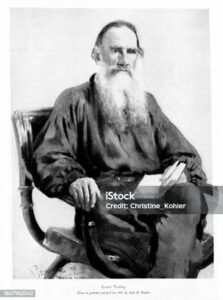 Widely considered by many readers, authors, and critics to be one of the world’s greatest writers, Leo Tolstoy remains a towering presence in the literary world. Among his vast literary output stand his two fictional masterpieces: War and Peace and Anna Karenina. Epic in its scope, War and Peace chronicles the French Emperor Napoleon’s disastrous invasion of Russia in 1812 as seen through the eyes of several Russian aristocratic families. Anna Karenina is an intimate psychological portrait of an unhappily married aristocratic Russian woman who pursues an extra-marital affair with another man, only to encounter scandal, social isolation, and a growing sense of despair that ultimately drives her to take her own life.
While he explored various themes in his short stories, novellas, and novels, Tolstoy also developed over time a practical writer’s mindset that guided him as he composed his stories. His approach to writing is one that any author might find helpful.
- A writer should only write when they feel an all-consuming desire to tell a story – once the writing begins, Tolstoy firmly believed that the writer had no reason to hurry the writing process along, and that he or she should not begrudge the daily toil of correcting and revising their prose ten or even twenty times. Tolstoy prized clear and concise writing and he was forever editing his own stories. As he once remarked, “. . . write as it comes, at length, and then revise it, and above all shorten it. In the business of writing, gold is only obtained, in my experience, by sifting.”[i] As he matured as a writer, Tolstoy’s developmental prose exhibited in his early writings like The Cossacks and Sevastopol Stories gave way to a masterly writing style in later stories like Anna Karenina and Hadji Murat.
- Preparation for writing is of paramount importance to the writer – Tolstoy felt that a writer should be prepared to sift through one thousand thoughts before writing down one good, true impression or idea. As he stated, “Just as in speech the spoken word is silver and the unspoken one gold, so in writing – – I would say that the written word is tin, and the unwritten one gold . . .”[ii]
- Allow your characters to express their humanity – Tolstoy deftly entered into the minds of his various fictional characters in order to fully reveal their thoughts, feelings, desires, hopes, inner conflicts, and imperfections, all the while not judging them as a writer. For example, in composing his novella, Hadji Murat, Tolstoy sought to portray the “fluidity” of human nature, and created a character whose many-faceted nature – strong man and weakling, sage and fool, villain and angel – revealed inner conflicts that led inexorably to his death.[iii]
- Describe common objects and concepts in new ways – readers who encounter a familiar concept or an object in a story will more often than not simply skip over it without a thought. Tolstoy consciously applied the Russian term ostranenie (defined as the “art of making strange”) in his works, turning the common into something new, even strange, for the reader to experience.[iv] For example, in his novella, Strider: The Story of a Horse, Tolstoy talks about issues like prejudice, fortune, and death through the first-person narrative voice of an aging horse named Strider.
Leo Tolstoy’s practical approach to writing, a mindset that he developed in the early years of his nearly six-decade career as an author and never renounced, offers the contemporary writer a path to follow in the daily toil, frustration, and joy that is the life of every author.
[i] Alexandra Popoff, “Tolstoy’s Writing Advice,” Literary Biographies, May 21, 2014, https://russianliteratureandbiography.com/505/
[ii] Popoff, “Tolstoy’s Writing Advice.”
[iii] Paul Foote, Introduction to The Cossacks and Other Stories, by Leo Tolstoy (Penguin Books, 2006), xxiv.
[iv] Abi Zipwinkel, “How Tolstoy Can Dramatically Improve Your Writing With One Russian Word,” Medium, July 11, 2017, https://medium.com/@AbiZip/how-tolstoy-can-dramatically-improve-your-writing-with-one-russian-word-87189ce5520e