John le Carré – The Spy as Writer
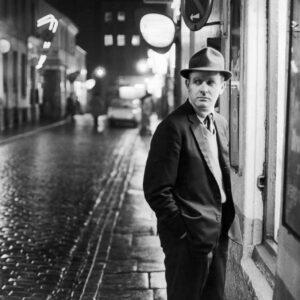 John le Carré is widely known for his masterful and intricately plotted Cold War-era espionage novels and post-Cold War novels of political intrigue. Born David John Moore Cornwell in 1931, he served in the British Army’s Intelligence Corps in the early 1950s before completing a first-class degree in modern languages at the University of Oxford. He taught German and French at Eton College for several years before he joined Great Britain’s domestic intelligence agency – MI5 – in the late 1950s. It was during his time in MI5 that he wrote his first novel, Call For the Dead, under the pen name John le Carré.
In 1960, he transferred to Great Britain’s Secret Intelligence Service (SIS) – MI6 – and worked under cover in the British Embassy in Bonn, West Germany. It was while serving in MI6 that John Le Carré published his second novel, A Murder of Quality, in 1962. His third novel, The Spy Who Came in from the Cold, written during a time of personal emotional upheaval, became an international bestseller when it was published in 1963 and brought him widespread acclaim.
Critical and commercial success continued with his other Cold War espionage novels, among them the so-called Karla Trilogy – Tinker, Tailor, Soldier, Spy, and The Honourable Schoolboy, and Smiley’s People – as well as a series of post-Cold War novels of political conspiracy such as The Tailor of Panama and The Constant Gardner.
Transitioning from the world of espionage to being a writer, John le Carré developed and maintained a disciplined approach to the craft of writing. Describing himself as an “absolute monk” when it came to his work, he rose early every morning and handwrote until noon. In the afternoons, while his wife typed up his work, he would go for a walk. When he returned home, he would meticulously revise what his wife had typed up, but he would always retire for the night before he finished all of his corrections, knowing in his mind where he would continue his writing the next morning.
In addition to John le Carré’s daily writing routine, several aspects of his writing style might serve as useful guides for writers of every genre:
character description:
Writers often struggle with how best to describe their characters without giving the reader too little or too much sensory information. John le Carré creates for his readers vivid and realistic images of characters who inhabit his novels. The fictional character Alec Leamas, the protagonist in John Le Carré’s breakout novel, The Spy Who Came in from the Cold, is deftly described as follows:
“Leamas was a short man with close, iron-grey hair, and the physique of a swimmer. He was very strong. This strength was discernible in his back and shoulders, in his neck, and in the stubby formation of his hands and fingers. He had a utilitarian approach to clothes, as he did to most other things, and even the spectacles he occasionally wore had steel rims. Most of his suits were of artificial fibre, none of them had waistcoats. He favoured shirts of the American kind with buttons on the points of the collars, and suede shoes with rubber soles. He had an attractive face, muscular, and a stubborn line to his thin mouth. His eyes were brown and small; Irish, some said. It was hard to place Leamas. If he were to walk into a London club the porter would certainly not mistake him for a member; in a Berlin night club they usually gave him the best table. He looked like a man who could make trouble, a man who looked after his money, a man who was not quite a gentleman.”
George Smiley, the fictional character (and protagonist) in the series of Cold War-era espionage novels that comprise the Karla Trilogy, is likewise adeptly described:
“Mr. George Smiley was not naturally equipped for hurrying in the rain, least of all at dead of night. . . . Small, podgy, and at best middle-aged, he was by appearance one of London’s meek who do not inherit the earth. His legs were short, his gait anything but agile, his dress costly, ill fitting, and extremely wet. His overcoat, which had a hint of widowhood about it, was of that black loose weave which is designed to retain moisture. Either the sleeves were too long or his arms were too short, for, . . . when he wore his mackintosh, the cuffs all but concealed the fingers. For reasons of vanity he wore no hat, believing rightly that hats made him ridiculous. “Like an egg-cosy,” his beautiful wife had remarked not long before the last occasion on which she left him, and her criticism, as so often, had endured. Therefore the rain had formed in fat, unbanishable drops on the thick lenses of his spectacles, forcing him alternately to lower or throw back his head as he scuttled along the pavement that skirted the blackened arcades of Victoria Station.”
writing to discover:
While some writers purposefully plan or outline their stories, other writers “discover” their story along the lines of E. L. Doctorow’s observation that, “writing is like driving at night in the fog. You can only see as far as your headlights, but you can make the whole trip that way.”
John le Carré approached his writing by “discovering” each of his stories, allowing them to unfold organically, even unexpectedly, without little or no regard for direction. He “lived” his characters as he drafted his stories, and he oftentimes thought out the twists and turns of his stories’ plots and his characters’ dialogue during his daily walks. For John le Carré, every story began with the idea of a strong character like Alec Leamas or George Smiley, and then, as he stated, “I have to put him into conflict with something, and that conflict usually comes from within.”
in medias res:
As with some writers, most of John Le Carré’s stories begin in medias res, or “in the middle of things,” in order to immerse the reader into the story. Flashbacks are used to fill in the context and the background of the characters introduced in the opening scenes. For example, in the novel, The Spy Who Came in from the Cold, the opening chapter plunges the reader right into the middle of an extended Cold War-era scene at a heavily guarded crossing point between East and West Berlin:
“The American handed Leamas another cup of coffee and said, ‘Why don’t you go back and sleep? We can ring you if he shows up.’
Leamas said nothing, just stared through the window of the checkpoint, along the empty street.
‘You can’t wait for ever, sir. Maybe he’ll come some other time. We can have the polizei contact the Agency: you can be back here in twenty minutes.’
‘No,’ said Leamas, ‘it’s nearly dark now.’
‘But you can’t wait for ever; he’s nine hours over schedule.’
‘If you want to go, go. You’ve been very good,’ Leamas added. ‘I’ll tell Kramer you’ve been damn’ good.’
‘But how long will you wait?’
‘Until he comes.’
Leamas walked to the observation window and stood between the two motionless policemen. Their binoculars were trained on the Eastern checkpoint.
‘He’s waiting for the dark,’ Leamas muttered. ‘I know he is.’
‘This morning you said he’d come across with the workmen.’
Leamas turned on him.
‘Agents aren’t aeroplanes. They don’t have schedules. He’s blown, he’s on the
run, he’s frightened. Mundt’s after him, now, at this moment. He’s only got one
chance. Let him choose his time.’”
While the character of Alec Leamas is introduced to the reader in the first chapter of the novel, it is in the second chapter that John Le Carré more fully reveals Alec Leamas’s personality and background:
“Leamas was not a reflective man and not a particularly philosophical one. He knew he was written off—it was a fact of life which he would henceforth live with, as a man must live with cancer or imprisonment. He knew there was no kind of preparation which could have bridged the gap between then and now. He met failure as one day he would probably meet death, with cynical resentment and the courage of a solitary. He’d lasted longer than most; now he was beaten. . . . Ten years ago he could have taken the other path—there were desk jobs in that anonymous government building in Cambridge Circus which Leamas could have taken and kept till he was God knows how old; but Leamas wasn’t made that way. . . . He had stayed on in Berlin, . . . stubborn, wilful, contemptuous of instruction, telling himself that something would turn up. Intelligence work has one moral law—it is justified by results.”
Espionage novels may not be to everyone’s taste or liking, but an understanding of the daily writing habits and approaches to the craft of writing of authors like the late John Le Carré will benefit writers of every genre.