“Write One True Sentence” – Ernest Hemingway and the Craft of Writing
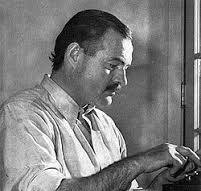 Ernest Hemingway, born in Oak Park, Illinois, in 1899, wrote more than a dozen works of fiction and non-fiction during his life, among them A Farewell to Arms, For Whom the Bell Tolls, The Sun Also Rises, and Death in the Afternoon. His posthumously published works include Islands in the Stream, The Garden of Eden, and A Moveable Feast, a memoir of his time in Paris, France, in the 1920s. He also wrote more than fifty short stories, most notable among them The Short Happy Life of Francis Macomber, The Snows of Kilimanjaro, Big Two-Hearted River, Hills Like White Elephants, and A Clean, Well-Lighted Place. He was awarded the Pulitzer Prize in 1953 for his novella, The Old Man and the Sea, and received the Nobel Prize for Literature in 1954 for, as the Nobel Prize Committee stated, “. . . his mastery of the art of narrative . . . and for the influence that he has exerted on contemporary style.”
During his apprenticeship as a newspaper reporter for the Kansas City Star and later as a newspaper reporter and foreign correspondent for the Toronto Star, Ernest Hemingway developed his revolutionary style of spare, direct writing. Beyond his unadorned literary style, Hemingway also developed a method or approach as a writer that anchored him while he authored his short stories, non-fiction works, and novels. More a set of principles than a collection of hard and fast rules, Hemingway’s approach still offers lessons for today’s writers.
Study the masters
Throughout his life, Hemingway was a voracious reader and his personal library contained some nine thousand books. He read widely and thoughtfully, and was particularly influenced by Mark Twain, Leo Tolstoy, Stephen Crane, Gustave Flaubert, and Ivan Turgenev (“read all of Turgenev,” Hemingway once remarked). In addition to his extensive reading habits, Hemingway studied the visual arts while he lived in Paris, especially the post-Impressionist painter, Paul Cézanne, whose series of landscape paintings inspired Hemingway’s method of making the reader “see” and experience the landscapes in his stories.
Stop when you know what will happen next in your story
A common challenge faced by every writer is the so-called “writer’s block,” that moment when a writer does not know what he or she is going to write next. Hemingway made it his habit to stop when his writing was going well in order to have something to write about the next day. As he once remarked,
“The best way is always to stop when you are going good and when you know what will happen next. If you do that every day when you are writing a novel you will never be stuck. . . . Always stop when you are going good and don’t think about it or worry about it until you start to write the next day. That way your subconscious will work on it all the time. But if you think about it consciously or worry about it you will kill it and your brain will be tired before you start.”
Begin each day by reading over everything you have already written
Continuity in tone and structure is one of the major tenets in writing. Ernest Hemingway made it a daily habit to re-read everything he had written up to that moment and make any necessary corrections as he re-read his writing. As he said,
“The best way is to read it all every day from the start, correcting as you go along, then go on from where you stopped the day before. When it gets so long that you can’t do this every day read back two or three chapters each day; then each week read it all from the start. That’s how you make it all of one piece.”
All writing is re-writing
Hemingway once remarked that, “the only kind of writing is rewriting.” and he strongly believed that a writer needed self-discipline in order to effectively re-write a scene, a chapter, or an entire novel. Archival research has shown that Hemingway re-wrote the ending to his novel, A Farewell to Arms, forty-seven times. When he was asked why he revised the ending so many times, he replied, “getting the words right.” In that regard, Hemingway was likely inspired by his readings of the works of Gustave Flaubert and by that French writer’s guiding principle of “le mot juste” (the exact right word) when he authored his stories.
Ernest Hemingway’s artistic philosophy was deeply influenced by his lived experiences, by the authors he read and studied, and by his study of the visual arts, yet it was his hard-earned set of simple literary principles that always stood him in good stead as he crafted and revised his short stories and novels.